Meta TikTok Ads Scraper: Hunting Winning Products From Live Ads
How I built a Meta TikTok Ads Scraper in Python and API calls to collect live ads data, filter dropshipping-relevant creatives, and push valid records into a winning-product hunting web application.
Project overview
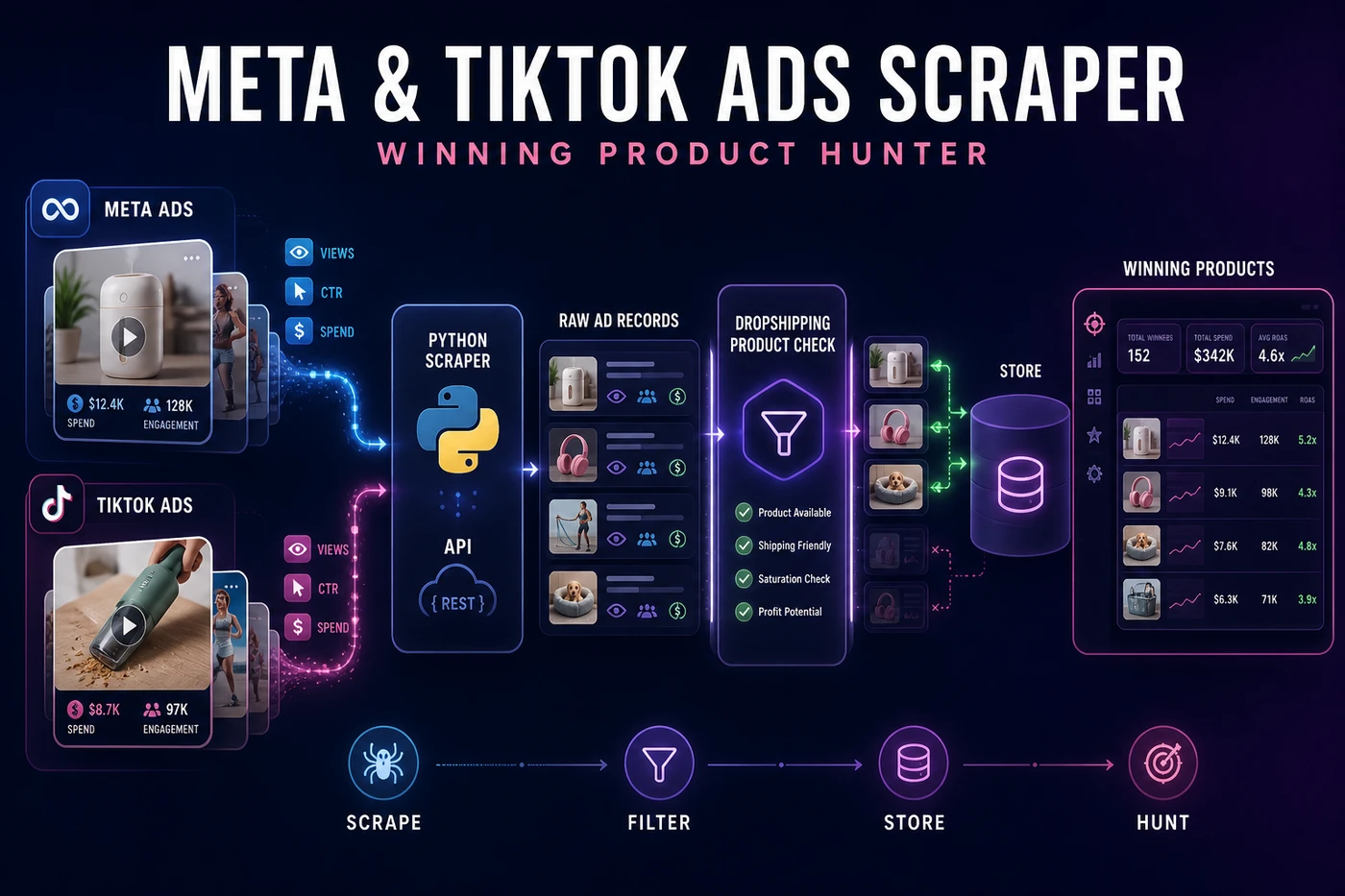
Meta TikTok Ads Scraper is the data engine behind a web application I built to help operators hunt winning products from live advertising activity. Instead of browsing ad libraries one creative at a time, the scraper collects ads data from Meta and TikTok through Python and API integrations, evaluates whether each ad points to a dropshipping-style product opportunity, and stores only the valid records in the application database.
The useful product is not “more ads in a spreadsheet.” It is a repeatable pipeline that turns noisy market creatives into structured product and ads intelligence the web application can search, filter, and review.
The product problem
Winning-product research usually starts where demand is already being tested: paid social. Meta ads and TikTok ads show which offers are getting creative investment, which angles are being repeated, and which product categories keep appearing across advertisers. The hard part is turning that observation into durable data.
Manual research does not scale. Screenshots go stale. Spreadsheets lose context. A scraper that collects everything without filtering creates a different problem: a database full of brand ads, local services, and non-product campaigns that do not help a dropshipping operator decide what to test next.
What the system had to deliver
- Collect live ads data from Meta and TikTok through Python and API calls
- Normalize creatives, offer signals, and supporting metadata into one schema
- Filter out ads that are not relevant to dropshipping product hunting
- Push only validated records into the web application database
- Keep the pipeline repeatable so the product library can stay fresh
How the Meta TikTok Ads Scraper works
1. Collect ads data from Meta and TikTok
The scraper is written in Python and talks to the platforms through API-driven collection. Meta and TikTok each expose different ad shapes, so the first job is to pull the available creative and campaign signals into a common processing path rather than treating each platform as a separate research habit.
Collected records typically include creative assets or previews, advertiser or page context when available, landing and offer clues, and the platform metadata needed to de-duplicate and refresh the same ad later.
2. Normalize the raw payload
Raw API responses are platform-specific. Before any filtering happens, the scraper maps both Meta and TikTok payloads into one internal record shape the web application can understand: product-facing fields, creative references, platform source, and the signals used later for dropshipping relevance.
Normalization is what makes cross-platform hunting possible. Without it, the dashboard would need two product browsers and two definitions of “valid.”
Filtering for dropshipping-relevant ads
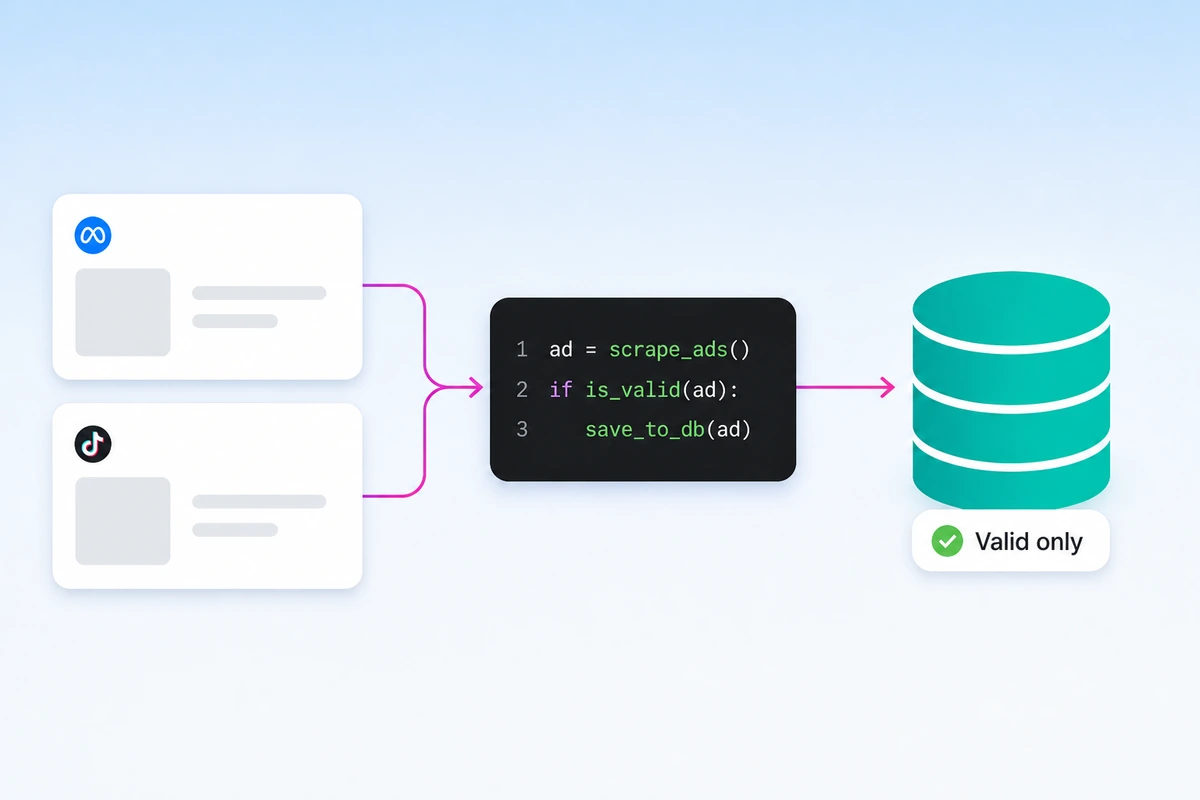
After collection, every record passes through a relevance filter. The question is not only “is this an ad?” It is “is this ad useful for hunting a dropshipping product?”
The filter looks for product-commerce signals and rejects ads that are clearly outside the use case: pure brand awareness, local services, non-physical offers, or other creatives that would pollute a winning-product database. Only ads that clear the check continue to storage.
That decision is deliberate. A smaller database of relevant ads is more valuable than a larger database of everything the APIs returned.
Pushing validated data into the web application
Valid ads and product signals are written into the application database that powers the winning-product hunting interface. From there, users can review creatives, compare offers, and decide which products deserve deeper research without having to run the scraper themselves.
The write path is designed around freshness and uniqueness. Re-running the scraper should update known ads and add newly discovered ones, not flood the product library with duplicates of the same creative.
End-to-end flow
- Python scraper requests Meta and TikTok ads data through API integrations
- Payloads are normalized into one internal ads and product schema
- Each record is checked for dropshipping product relevance
- Invalid or out-of-scope ads are discarded before storage
- Valid records are pushed to the web application database for hunting and review
From market signal to merchant action
Ads intelligence becomes more useful when it connects to the rest of a merchant workflow. Validated records flow into Product Hunter inside the merchant dashboard, where hot-selling opportunities can be reviewed before anything is pushed to Shopify.
The scraper answers where a product candidate came from; the merchant still decides whether its demand, margin, supplier, and audience make it worth testing.
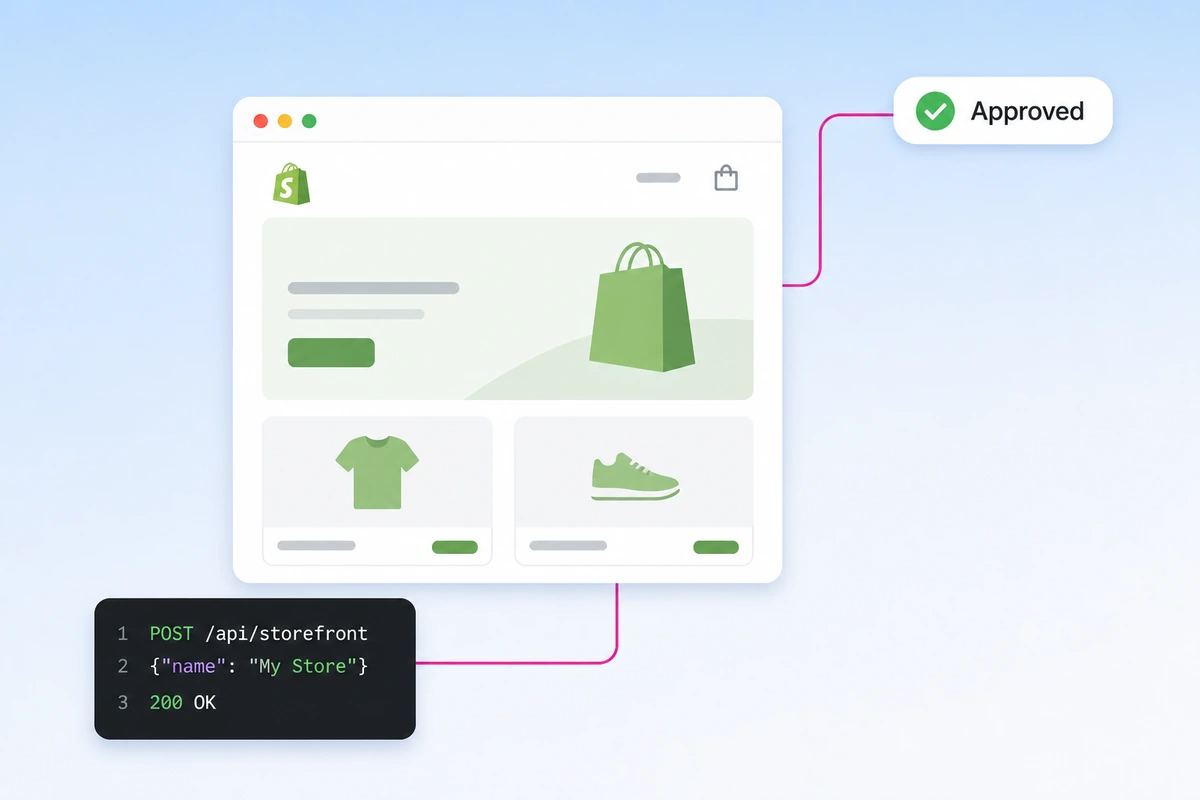
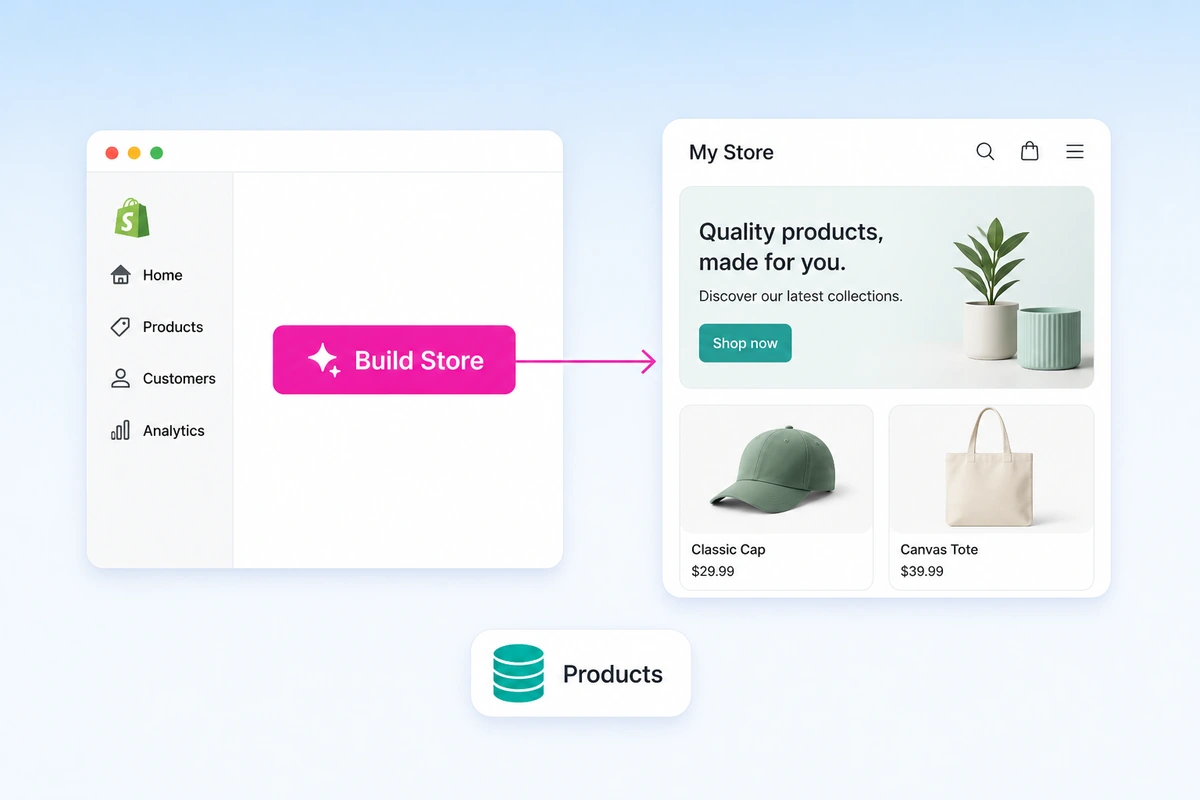
For candidates that pass that review, the store-building workflow turns the research into a Shopify storefront and catalog.
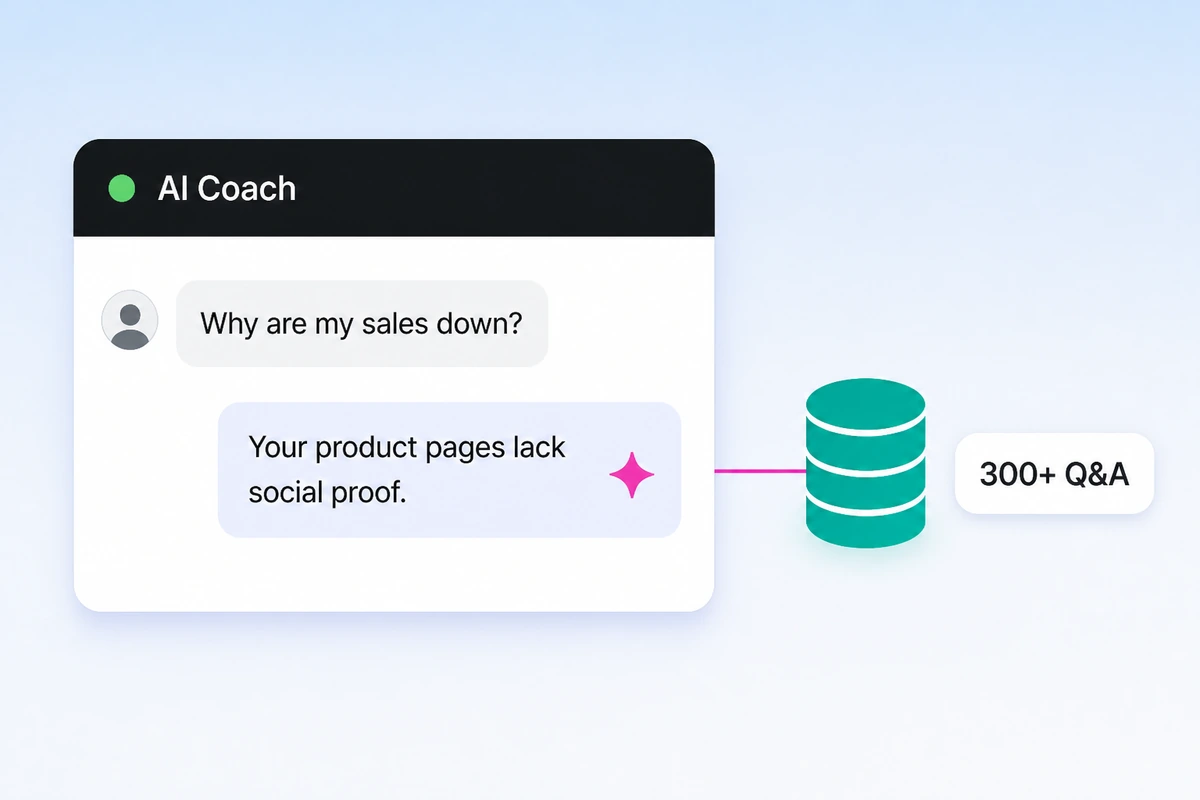
Once the store is live, a retrieval-first coaching layer helps the merchant decide what to improve next, using vetted answers before falling back to a model.
Architecture choices
Python owns the scraping and filtering pipeline because the work is batch-oriented, API-driven, and easy to schedule or re-run as a service. The web application owns browsing, search, and review. Keeping those concerns separate means the scraper can improve collection quality without rewriting the product UI, and the UI can evolve without knowing how Meta or TikTok payloads looked yesterday.
Credentials, rate limits, and environment configuration stay outside the codebase. Failures are treated as pipeline events: a platform timeout or a rejected payload should not silently invent a product record.
Tradeoffs
Filtering aggressively reduces noise, but it also means some edge-case creatives never reach the database. I preferred a cleaner hunting library over an exhaustive dump of every ad the APIs could return.
Cross-platform normalization also costs engineering time up front. The payoff is one hunting experience instead of two disconnected research tools that never share a definition of a valid product opportunity.
Outcome
- Built a Python and API-based Meta TikTok Ads Scraper for live ads collection
- Normalized Meta and TikTok payloads into one product-hunting schema
- Filtered records for dropshipping product relevance before storage
- Pushed only validated ads and product data into the web application database
- Connected market ads intelligence to a repeatable winning-product hunting workflow
The scraper is valuable only after the filter. Collection finds the market; validation decides what belongs in the product database.
What I learned
Ads collection without relevance rules creates research theater: lots of activity, little decision quality. The important engineering work was the boundary between “an ad exists” and “this ad is useful for hunting a dropshipping product.”
I also learned that the database write is part of the product, not a side effect. If duplicates, stale creatives, or non-product ads enter the library, the hunting interface becomes less trustworthy no matter how polished the UI looks.
- Meta TikTok Ads Scraper
- Meta Ads
- TikTok Ads
- Python
- API Integration
- Dropshipping Product Filter
- Winning Product Hunter
- Ads Data Pipeline
- Product Database